
June 2027 |

London Climate Action Week

Roundtables & Partner Events

*ROUNDTABLES & PARTNER EVENTS FOR OUR 2027 EDITION ARE LIMITED.

PLEASE CONTACT US AT INFO@CLIMATEACTION.ORG TO SECURE YOUR PARTNER EVENT OR ROUNDTABLE EARLY.

Hosted by

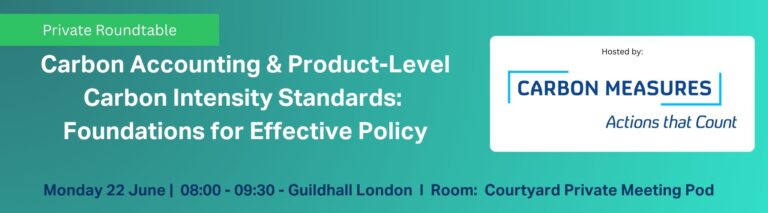
As part of London Climate Action Week – Climate Innovation Forum, Carbon Measures is convening an invitation-only breakfast roundtable bringing together a select group of senior leaders, policymakers, and industry experts for an open and candid discussion on the critical policy and market issues shaping the future of climate action.

At a time when data credibility, transparency, and practical implementation are increasingly central to accelerating the transition to a low-carbon economy, robust carbon accounting and product-level carbon intensity standards are emerging as essential foundations for effective policy and market decision-making.
Hosted by
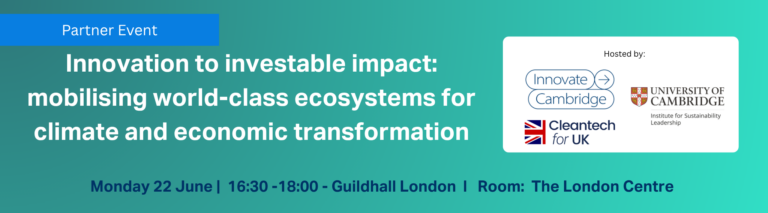
Hosted by the University of Cambridge Institute for Sustainability Leadership (CISL), Innovate Cambridge, Cambridge Zero and Cleantech for UK, this session will focus on how place-based ecosystems can act as delivery engines for innovation, investment and adoption.
The discussion is designed to surface where progress most often stalls between innovation, capital and implementation, and what is needed – from policy, market design and partnerships to unlock deployment at scale.
This is a closed, Chatham House discussion, with a short framing followed by a panel and audience-led Q&A.
For attendees, this is an opportunity to:
Hosted by

To answer the central question of how to build the Brazilian market around three key pillars:
integrity, insurability, and investability.

The proposal is to gather experts and key figures in the carbon market for a practical and
forward-looking discussion on the main challenges and pathways related to credibility, risk
management, ratings, transparency, traceability, and the evolution of trust mechanisms in the
global carbon market. The focus of the meeting is less institutional and more geared towards the
exchange of technical and strategic insights regarding the future of the climate transition and the
sector’s integrity infrastructure.

Hosted by

Innovative solutions are critical to adapt to the accelerating impacts of climate change, as traditional approaches alone cannot meet the scale and complexity of the challenge. A diverse set of organisations are already financing and supporting adaptation innovation across regions and sectors. However, there is potential for strengthening cooperative action amongst stakeholders to accelerate, encourage, and enable an effective ecosystem of innovative adaptation solutions.

The Adaptation Fund is convening a roundtable that will bring together funders and partners supporting adaptation innovation to discuss how the funding landscape is evolving, where overlap and fragmentation persist, and how stronger coordination could help build a more coherent and effective ecosystem.

Hosted by

Achieving agricultural transition at scale requires new ways of mobilising capital. This invitation-only roundtable will bring together leaders from Unilever, Itaú and IDB Invest to discuss how blended finance structures can unlock private investment, align commercial and sustainability objectives, and accelerate impact across agricultural supply chains.

The session will be held under Chatham House Rule and designed as an interactive discussion among a select group of senior representatives from financial institutions, corporates, development finance institutions and impact investors.

22 June 2026 | 13:45 - 16:00
Hosted by

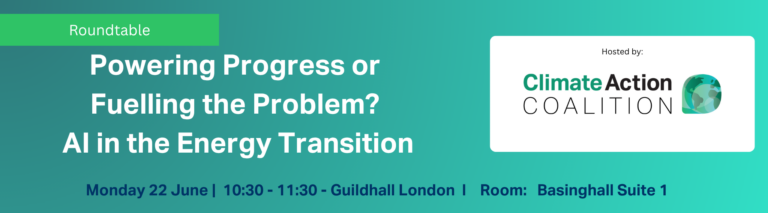
The rise of AI across society is one of the greatest challenges to the energy transition, with electricity demand for data centres and computing expected to increase significantly over the next decade and beyond. Yet AI also presents one of the greatest opportunities to reinvent and reimagine how to better produce energy and to reduce energy demand, through optimisation, digitisation of processes, greater efficiencies and machine learning. The inaugural AI Solutions Showcase is the first event at LCAW to bring to the stage some of those solutions that can make a significant difference in helping to accelerate the energy transition at the same time as reducing emissions and reducing costs. The showcase is the culmination of the work of the Climate Action Coalition’s AI Solutions Taskforce and will highlight the report’s recommendations in addition to providing a unique platform to highlighting how AI solutions can provide the answers to the challenges we will face for the future. The showcase will be divided into two key areas of focus- recognising that solutions can be found both across the AI energy ecosystem as well as delivering positive change in our wider energy systems.
Hosted by

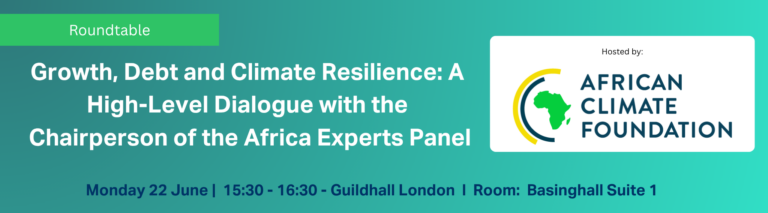
Development Finance and Climate Resilience

Join us for a critical dialogue as we explore the complex relationship between debt, development, and climate resilience. As we continue to feel the pressure from mounting fiscal and development challenges exacerbated by climate shocks – including the impacts of the Super El Niño – it is imperative that we rethink our approach to economic growth.

Hosted by

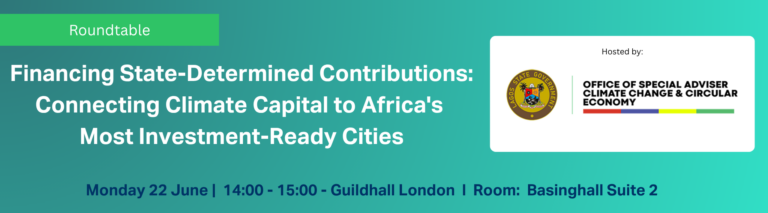
As climate finance increasingly shifts toward implementation and measurable impact, cities are emerging as critical drivers of climate action. Yet many subnational governments continue to face significant barriers in accessing the capital, partnerships, and technical expertise required to deliver transformative climate projects at scale.

This executive roundtable will convene a select group of investors, development finance institutions, climate funds, corporates, policymakers, and technical partners to explore how innovative financing models and strategic partnerships can accelerate climate implementation in Africa’s cities.

The discussion will spotlight Lagos State’s pioneering State-Determined Contributions (SDCs) Framework—a practical model that translates climate ambition into investment-ready opportunities across clean energy, sustainable mobility, circular economy, climate resilience, carbon markets, and nature-based solutions.

Why Attend?

Participants will gain exclusive insights into Lagos State’s climate investment pipeline and engage directly with senior government representatives responsible for shaping one of Africa’s most ambitious subnational climate agendas.

The session will also provide opportunities to:

  • Explore investment-ready climate projects and financing opportunities
  • Connect with decision-makers, investors, and implementation partners
  • Discuss innovative approaches to climate finance mobilization
  • Examine the role of cities in delivering global climate commitments
  • Identify partnership opportunities across energy, mobility, resilience, and carbon markets

Featured Climate Opportunities

  • 80 Million Clean Cookstoves Initiative
  • Low-Carbon Mobility & E-Mobility Programme
  • Lagos Carbon Platform
  • Circular Economy & Waste-to-Value Projects
  • Nature-Based Solutions & Coastal Resilience
  • Adaptation & Early Warning Infrastructure
Hosted by

The event bridges the City of London with the vanguard of Brazilian AgTech and sustainable finance, showcasing a live blueprint for low-carbon agriculture. Framed around the landmark Greenway program for the Conversion of Degraded Pastures, the session demonstrates how economic yield and sustainable agriculture thrive together. Top-tier traditional financial institutions will join pioneering impact investors to explore blended finance, private funds and other instruments that effectively de-risk large-scale land restoration for global capital. Moving from funding to fieldwork, leading innovators will showcase the scalable deployment of bioinputs and green fertilizers. Ultimately, participants will gain an exclusive, high-level understanding of how Brazil is blending public frameworks, private liquidity, and bio-based technologies to establish a predictable, high-yield, and deforestation-free pipeline for international green

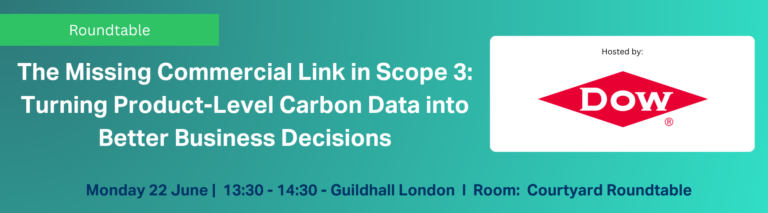
Hosted by

As net-zero commitments accelerate and enter a new phase of scrutiny, companies are under growing pressure to show not only that emissions are being measured, but that credible actions are being taken and reductions can be traced, validated, and connected to real business decisions.

This executive roundtable will explore how trusted product-level carbon data can help organizations drive more informed investment, innovation and decarbonization decisions, while enabling greater transparency and collaboration across industries. Dow’s Haley Lowry, Global Sustainability Director, and Peter Sandkuehler, Senior Director Sustainability EMEA, will share practical insights on how evolving approaches to traceability and validation, including Dow’s Carbon Footprint Ledger methodology, can support credible emissions reductions and help create long-term business value.

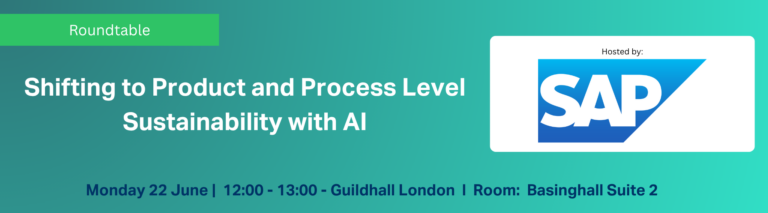
Hosted by
An AI and ERP-centric approach to material transition, supply chain resilience and carbon accounting for compliance at scale (DPP, PPWR, CBAM, EUDR) and a future proof sustainable transformation journey.
Hosted by

For organizations committed to climate action, the question is no longer whether to act — but how to accelerate impact now while building long-term resilience. This session spotlights a critical, often overlooked lever: superpollutants.

Nitrous oxide (N₂O) and methane are significantly more potent than CO₂ and linger in the atmosphere for years. Proven abatement solutions exist today — and companies investing in them are seeing outsized near-term climate returns alongside measurable business value.

Bill Flederbach, CEO of ClimeCo, and Michelle Jolly, Director of Sustainability Solutions and Services at Amazon, will explore:

  • Why leading companies are prioritizing superpollutant strategies now
  • How these investments deliver tangible business value
  • What barriers still exist to scaling adoption across industries and geographies
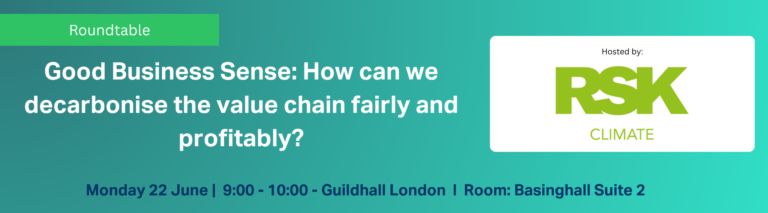
Hosted by

Decarbonising the value chain is no longer a peripheral sustainability goal – it is fast becoming a defining test of good business.

There are barriers to overcome: value chains are shared systems, but the levers for change are fragmented. However, if we can find ways to align priorities, the opportunity is huge – we can drive resilience, restore nature and unlock long-term value.

So, what does “good” really look like in practice?

As part of London Climate Action Week, this RSK Climate roundtable will bring together a diverse group of leaders and decision-makers – from government and nature stakeholders to investors, retailers and infrastructure organisations – to ask:

  • What does it look like to balance fairness and profitability – or are difficult trade-offs inevitable?
  • Where does policy support real-world ambitions – and where do they come into conflict?
  • How can capital accelerate change – or is it limiting progress?
  • What does collaboration look like when priorities, pressures and responsibilities differ across the chain?

With representation from RSK Group companies ADAS, Copper Consultancy, Edge Impact, Nature Positive and The Water Research Centre, RSK Climate will drive a discussion to explore how big-picture ambition connects to practical realities.

This session is a space for candid discussion and will take place under Chatham House rules. Participants will be encouraged to step beyond their own organisational lens to test assumptions and engage with perspectives they may not normally encounter.

Ultimately, this is about more than reducing emissions. It’s about rethinking how value chains function, and what responsible, resilient and profitable business looks like in a low-carbon future.

Hosted by
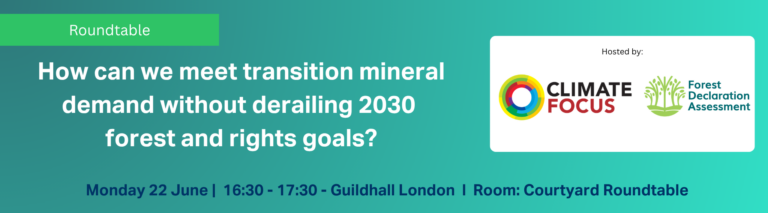
Hosted by Climate Focus as coordinator of the Forest Declaration Assessment, this roundtable will launch the Priority Actions for Mining and Mineral Supply Chains under the 2030 Global Forest Vision and use them to frame a practical discussion among business, finance, standards, and civil society leaders.
Critical minerals are essential to the energy transition, but scaling production must not come at the expense of forests, Indigenous Peoples, local communities, and human rights. This session will focus on how actors across the value chain—producers, buyers, investors, and standard setters—can better align mineral production, sourcing, finance, and disclosure with 2030 forest and rights goals.
The discussion will bring an investor and accountability lens to what “responsible” mining and sourcing look like in practice, drawing on both the new mining Priority Actions and existing work on deforestation- and conversion-free finance. It will explore where expectations are converging, where gaps remain, and what near-term actions are feasible across standards, due diligence, procurement, and capital allocation.
Through short inputs and a moderated discussion, participants will:
The session is designed as a working roundtable, with a focus on exchange, peer learning, and identifying actionable next steps.
Hosted by
This roundtable, designed for senior policymakers and market participants, will explore the evolving role of carbon markets in delivering credible decarbonisation.
Held at the Climate Innovation Forum, the 60-minute discussion will bring together a select group of public and private sector leaders, including senior UK Government representatives, to examine how recent and anticipated policy developments in the UK and beyond are reshaping market design, integrity and business incentives. The session will focus on the respective roles of policymakers and the market, and where better alignment could help unlock greater impact in support of net zero ambitions.
Through a facilitated discussion, participants will share perspectives, surface practical insights and identify forward-looking actions to improve clarity, confidence and participation in carbon markets. The roundtable will be supported by a series of short “firestarter” interventions from government, industry and senior ministerial representation linked to London Climate Action Week announcements.
Hosted by

Private capital is increasingly recognized as essential to closing the global financing gap for climate and biodiversity, but the market for investing in nature is still taking shape. Where do things stand today, and what signals are emerging about where capital will flow next?

Drawing on global data from a new report in a multi-year benchmark series by The Nature Conservancy and Forest Trends, this session will map how private capital for nature has evolved, where it is currently being deployed and where momentum is building. A senior panel of capital providers will explore persistent barriers, including pipeline, risk-return dynamics, and enabling policy drivers, and highlight where innovation and collaboration are unlocking new opportunities.
Designed for decision-makers across the financial spectrum, this session offers a clear snapshot of the market today and practical insight into how private capital can scale in the years ahead.

Hosted by

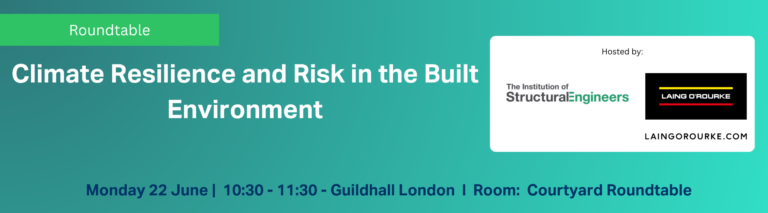
Senior stakeholders from across the built environment and related sectors will come together to discuss what climate resilience means in practice for business across the value chain, and how collaboration can help shape effective policy and regulation to minimise risk and maximise long term outcomes.

Hosted by

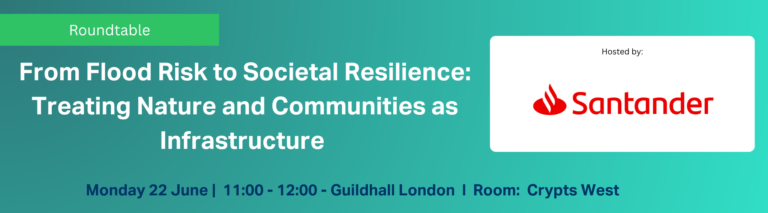
Climate risk in the UK is no longer a distant threat. It’s already reshaping homes, businesses, and local economies. Flooding, in particular, is emerging as a systemic challenge, with implications for property values, SME resilience, insurance access, and regional stability.

In this roundtable, Santander will share insights from its collaboration with the University of Exeter, exploring how nature-based solutions (NbS) can help manage flood risk. We’ll examine where these approaches can deliver measurable impact, their limitations, and what it takes to scale them from local pilots into credible, investable infrastructure.

But resilience goes beyond physical assets. Disruption also tests people, businesses, and communities. It makes societal resilience a critical part of the conversation.

Join us for an open discussion to explore how to build coordinated, scalable solutions that strengthen both environmental and economic resilience in the UK.

Hosted by
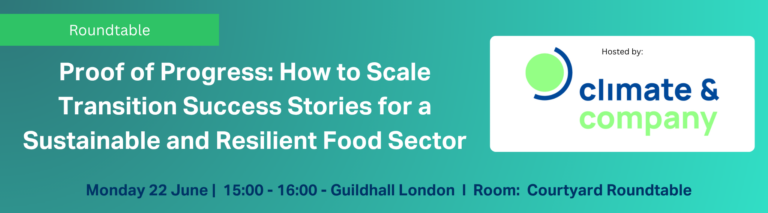
While the shifting policy landscape has created uncertainty, many companies, financial institutions, and partners across value chains continue to make tangible progress with the transition to sustainable business practice.
This roundtable brings together a select group companies from the food sector together with thought leaders from finance, philanthropy, civil society and research to showcase what is already working in terms of value chain transparency, data solutions, and leveraging policies for strategic benefits, including enhanced resilience. Together we will explore how to build on the progress demonstrated by front runners to foster broader momentum for the transition of our food sector.
Through short inputs and an interactive discussion, participants will:
  • Share concrete examples of collaboration across value chains that improves risk management, reduces geopolitical dependencies and contributes to sustainability goals.
  • Explore how data, financing, and partnerships can better connect upstream and downstream actors.
  • Identify practical opportunities to align ongoing initiatives and strengthen joint action.
The session is designed as a working roundtable, with a strong focus on exchange, peer learning, and identifying next steps for collaboration.
Moderator: Theresa Spandel, Strategy Lead at Climate & Company
Hosted by
Climate risk is accelerating, driving $4 trillion in global economic losses over the past decade and amplifying the most critical risks facing businesses, economies and communities. Yet financing for resilience is failing to keep pace.
This session explores how innovation across analytics, insurance and finance can help close this gap – and unlock resilience at scale. Through a dynamic two-part discussion, we examine the resilience finance value chain – who buys, who pays and who benefits – and how risk transfer can better align incentives and mobilise capital. We then turn to food and agriculture, showcasing real-world, execution-ready solutions that safeguard supply and attract investment into climate-resilient systems.
Hosted by

Fresh off the press and launching on the morning of the Climate Innovation Forum, join members of the AI Solutions Taskforce as they unveil the findings of their new report for the first time, spotlighting leading AI solutions supporting the energy transition. In recent years, we’ve seen both the expanding opportunities and emerging challenges driven by the rapid rise of AI – and its increasingly significant influence on climate and energy outcomes.

Convened by former UNFCCC Executive Secretary Ambassador Patricia Espinosa and former UK Energy Minister Chris Skidmore, the Taskforce brought together leading experts from business, industry, and finance. Over recent months, members have examined AI’s role in driving climate action – from unlocking its potential as a powerful enabler of the energy transition to addressing its own expanding energy demand and associated emissions. Join us to be among the first to hear their conclusions.

Hosted by

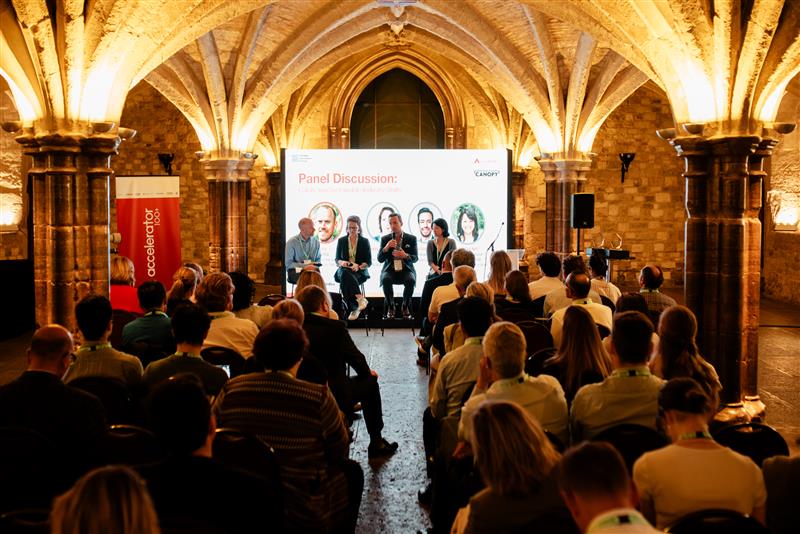
Hosted by the 100+ Accelerator, this event happening on the sidelines of London Climate Action Week brings together game-changing startups, sharp-eyed judges and sustainability leaders for a live showdown at London’s historic Guildhall.

The 100+ Accelerator is a global program co-sponsored by AB InBev, The Coca-Cola Company, Colgate-Palmolive, Danone, Mondelēz International and Unilever that partners with startups to rapidly pilot and scale breakthrough sustainability solutions and maximize collective impact.

Four startups from the program will pitch solutions across the theme of building a circular economy — from transforming industrial waste into valuable raw materials, designing industry-scale biomaterials, using AI-powered waste intelligence to improve recycling systems, to creating pigment from discarded algae cells.

After the pitches will be a rapid-fire dialogue on key innovation trends, followed by a networking reception where founders, funders, and changemakers connect.

22 June 2026 | 14:30 - 15:30
Hosted by

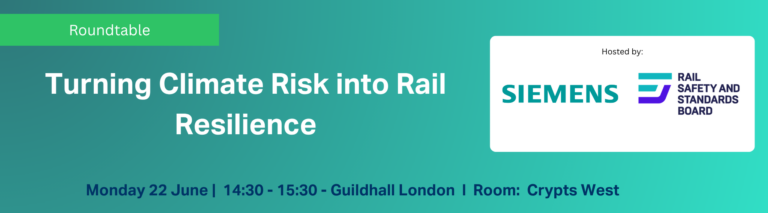
As climate risks intensify, rail networks face growing disruption from extreme weather, fragile supply chains, and underused data. This moderated roundtable brings industry leaders together to explore how digitalization and AI can strengthen climate resilience and accelerate mitigation across rail systems.

Participants will discuss how combining data from across rail infrastructure, operations, and weather systems can unlock better insights, predictions, and decisions. This will be an open discussion, Chatham House Rules do not apply.

Hosted by

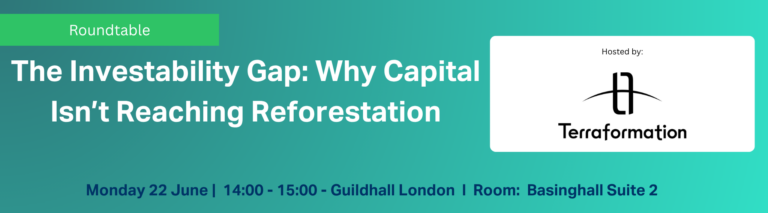
Capital is available for well-structured projects across many sectors, but isn’t reaching reforestation projects at the pace or on the terms required to meet the scale the climate needs. Project economics have to work for developers for the market to scale.

This roundtable will explore why that gap persists and what it will take to close it, drawing on everyone’s real-world experience: where capital is and isn’t flowing, which financial mechanisms are being deployed and where they’re falling short, and what it would actually take to move more capital into reforestation.

Attendees are encouraged to bring their own experience and ideas to support, challenge, or suggest alternatives to shape the direction of the discussion.

Hosted by

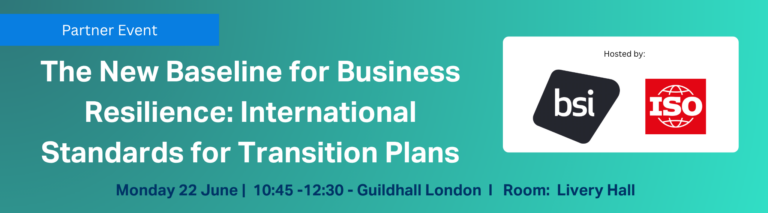
As climate action moves from ambition to implementation, organizations are looking for practical and globally aligned tools to support resilience, transition planning and sustainable finance. International standards play a critical role in helping organizations strengthen performance and confidence, while enabling more consistent and scalable climate action across markets and society.

This session will explore what the international standards system can do for climate action, and how collaboration across standards bodies, business, finance, policymakers and global initiatives can help address critical challenges affecting organizations and markets worldwide. The event will mark the launch of the public consultation for the world’s first ISO net zero standard (ISO 14060). Through examples including the ISO–GHG Protocol partnership and the newly launched ISO 32212 standard for transition planning in financial institutions, the discussion will examine how international collaboration can reduce fragmentation, strengthen interoperability and help organizations navigate the climate transition with greater confidence.

Join senior leaders from ISO, GHG Protocol, BSI and partners for a high-level discussion on how international collaboration in standards development can strengthen resilience, support credible transition planning and accelerate implementation.

Hosted by

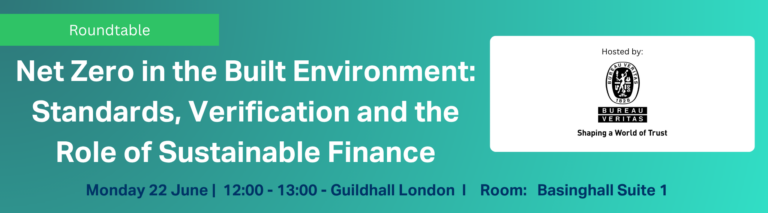
As the built environment moves from net zero ambition to delivery, organisations are facing a shared challenge: how to decarbonise existing real estate portfolios in a way that is credible, verifiable and scalable. Retrofit now sits at the centre of climate action – and confidence in standards and evidence has become critical.

This roundtable brings together senior decision‑makers across real estate, standards, verification and sustainable finance who are grappling with the practical realities of delivery. At its core is the UK Net Zero Carbon Buildings Standard (NZCBS), developed to address fragmentation in the market by providing a clear, consistent framework for credible net zero performance across building types and lifecycle stages.

The discussion will focus on how NZCBS is interpreted and operationalised at portfolio level, the role of independent verification in turning standards into trusted evidence, and how this credibility – including through the lender perspective of the Loan Market Association (LMA) – helps bridge the climate finance gap for retrofit, moving ambition into real‑world action.

Hosted by

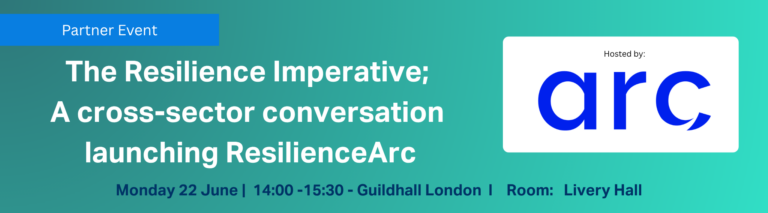
As physical climate risks intensify, markets face a growing resilience blind spot. This session brings together leaders from finance, insurance, corporates and policy to examine how climate shocks are already affecting operations and economic stability — and what decision-useful intelligence is still missing.
The session will introduce ResilienceArc – a new public access platform developed through a partnership between Arc, Earth Capital Nexus at the London School of Economics (LSE), and XDI (Cross Dependency Initiative) – offering consistent, comparable insight into corporate exposure, physical climate risk and adaptation readiness. By connecting quantified, asset-level climate risk analysis with emerging approaches to assessing corporate resilience action, the discussion will explore how shared data and cross-sector collaboration can support smarter investment, stronger disclosure and a more resilient global economy.


Agenda:

2.00pmWelcome remarks

MC: Federico Mazza – Senior Program Manager – Arc

2.03pmOpening Keynote: Resilience as the “next frontier” 

  • What London’s businesses, infrastructure and public services are already facing from extreme heat, flooding and cascading climate impacts.
  • Why resilience is now central to UK economic competitiveness, investment confidence and financial stability.
  • The need for coordinated, long‑term resilience planning across government, finance and industry, embedding adaptation into investment, risk and capital‑allocation decisions.

Speaker:

  • Professor Emma Howard Boyd CBE – Chair, National Heat Risk Commission | Chair, ClientEarth Group Board | Co-Chair, HERA (formerly Climate Resilience for All)
2.11pm Keynote: Navigating Real-World Physical Climate Impact — Spotlight on Extreme Heat

Themes:

  • Extreme heat is an “invisible” economic shock already costing hundreds of billions through lost productivity, infrastructure strain, supply‑chain disruption and rising insurance pressures.
  • Without major investment in resilience and adaptation, physical climate impacts will increasingly hit long‑term returns, insurability and economic stability.
  • Practical resilience solutions are emerging — from heat insurance for women workers to community‑led adaptation models and new capital‑allocation mechanisms that protect vulnerable communities and economic systems.

Speaker:

  • Kathy Baughman McLeod – Founder & CEO – HERA (formerly Climate Resilience for All)
2.19pmFireside Chat 1: The Market Signal – The resilience gap

Why markets are struggling to manage physical climate risk

Themes:

  • Insurance market pressures
  • Portfolio exposure
  • Supply chain vulnerability
  • Lack of comparability in resilience data

Host:

  • Dr Nicola Ranger – Executive Director – Earth Capital Nexus

Speakers:

  • Sudeshna Raychaudhuri – Senior Specialist, Climate – PRI
  • Rob Bailey – Senior Adviser – Oliver Wyman
  • Fiona Watson – Vice President of Corporate Performance – WBCSD
  • Lucian Peppelenbos – Managing Director, Head of Sustainable Investing Thought Leadership – Robeco


2.45pm


 Introducing ResilienceArc

  • Turning asset-level risk into corporate insight
  • Linking physical risk with disclosure frameworks
  • Decision usefulness for financial institutions and corporates


Speaker: Felix Preston – Director, Research and Program – Arc

2.58pm In Conversation: Building Partnerships and ResilienceArc

Themes:

  • How ResilienceArc builds on and integrates with existing frameworks
  • Assumptions behind the methodology, interoperability and visibility of data
  • How corporates and Financial Institutions can engage
  • What’s needed to build from here together

Host:

  • Federico Mazza – Senior Program Manager – Arc

Speakers:

  • Karl Mallon – Co-Founder and CEO – XDI
  • Roberto Spacey Martin – Lead, Resilience Alignment – Earth Capital Nexus
  • Anne Chataigne – Senior Programme Manager, Adaptation and Resilience – IIGCC
  • Farheen Altaf – Resilience and Adaptation Lead – CDP
 3.24pmClosing: Pathways for Action 

Invitation to:

  • Explore the analysis
  • Join testing cohorts
  • Participate in future workstreams
  • Contribute to platform development

Speaker: Meryam Omi – Chief Executive – Arc

3.30pmClose – join us for a demo at our exhibition stand


Hosted by

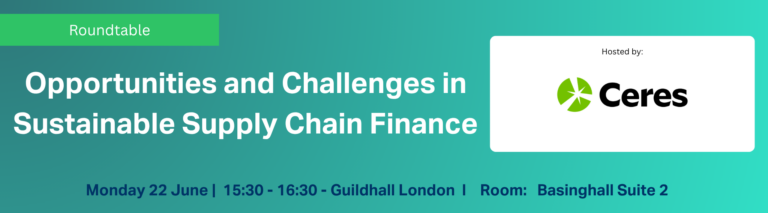
Companies are navigating how to move from climate transition planning to action. One important consideration is their supply chain. Companies must engage their suppliers in reducing pollution, and suppliers need the capital to fund their transition toward cleaner, resilient supply chains. Co-hosted by Ceres and Citi, this roundtable discussion will highlight the crucial role of banks and sustainable supply chain financing to support corporate transition planning and action. The aim of the roundtable is to foster a candid, solutions-oriented discussion on sustainable supply chain finance programs and transition planning.

22 June 2026 | 19:30 - 23:00
Hosted by

Climate Action and the London Climate Action Week Secretariat hosted the London Climate Action Week Gala Dinner at the iconic Guildhall on Monday, 22 June.

The prestigious evening brought together 380 leaders from the UK’s climate community alongside international guests to celebrate the eighth annual London Climate Action Week and the power of collective leadership in advancing global climate action.

The evening was brilliantly MC’d by Rachel Kyte and included rousing speeches from Nick Henry, Nick Mabey, Ed Miliband, and Teresa Ribera, as well as performances by Orchestra for the Earth, City Schools Consort, and Sibel Tuzun.

To those who joined us, we hope you had a fabulous evening!

Note if you are accepted to attend any Roundtable or Partner Event, your pass will also include access to the Climate Innovation Forum, as follows:

  • Main Stage programme, starting at 09:00 with the high-level opening of London Climate Action Week, and closing at 18:00 by Al Gore.
  • Nature Stage, Circularity & Zero Waste Stage, Finance Stage
  • Networking functions, including morning and afternoon refreshment breaks, lunch, and a drinks reception
  • The Innovation Exhibition and dedicated meeting spaces.
 
*PLEASE NOTE ALL ROUNDTABLES & PARTNER EVENTS ARE NOW CLOSED FOR APPLICATIONS – TO ACCESS A SIDE EVENT, CLICK ON ‘FIND OUT MORE’ BELOW AND CONTACT THE RELEVANT EVENT HOST DIRECTLY BY EMAIL.